Executive Summary
A 1,000 sq ft two-story casita at the Coco property is legally achievable and sits at the strongest possible legal position: 1,000 sq ft is exactly the floor set by Florida SB-48 (effective December 1, 2026), meaning Marathon cannot deny the size by ordinance after that date.
| Item | Status |
|---|---|
| Lot size requirement | ✓ 23,692 sq ft — 8x the 3,000 sq ft minimum |
| ADU size — SB-48 (eff. Dec 1, 2026) | ✓ 1,000 sq ft is the mandatory floor — cannot be denied |
| Zoning | ✓ RL/RM residential — ADUs permitted |
| Height | ✓ Two-story + rooftop deck ≈ 32 ft — under 42 ft cap |
| BPAS allocation | ⚠ Unknown queue — call Marathon Planning first |
| Main house size (Monroe County records) | 2,005 sq ft · 3BR/3BA · Built 1990 |
| Budget (mid-range, all-in) | $710K–$1.1M · center ~$909K |
The Property
| Field | Value |
|---|---|
| Address | 265 Avenue G, Marathon, FL 33050 |
| Parcel ID | 00364500-000000 |
| Key | Vaca Key |
| Lot size | 23,692 sq ft (~0.54 acres) |
| Current use | Primary residence — single family |
| Main house | 2,005 sq ft · 3BR/3BA · Built 1990 · Metal roof |
| Estimated value | ~$2.2M |
| Existing mortgage | ~$500K |
Legal Framework
Monroe County ADU Rules
| Rule | Code Value | Your Property |
|---|---|---|
| Minimum lot size | 3,000 sq ft | ✓ 23,692 sq ft |
| Main house size | — | 2,005 sq ft (Monroe County records) |
| Max ADU — old 40% rule | 800 sq ft OR 40% of principal | 40% × 2,005 = 802 sq ft — under your target |
| Max ADU — SB-48 floor (eff. Dec 1, 2026) | Cannot cap below 1,000 sq ft | ✓ 1,000 sq ft is legally protected |
| Max bedrooms | 2 | OK |
| Owner occupancy required | Historically yes | SB-48 prohibits blanket requirement |
Florida SB-48 (2025) — The Game Changer
Effective December 1, 2026. Three key preemptions:
- Cities cannot ban ADUs in single-family zones
- Cities cannot cap ADU size below 1,000 sq ft
- Cities cannot require owner-occupancy as a blanket condition
BPAS — The Real Bottleneck
Marathon's Building Permit Allocation System rations new dwelling units to manage hurricane evacuation capacity. ADUs typically require a BPAS allocation. Queue: 6–24 months. SB-48 may force Marathon to exempt ADUs from BPAS — not yet clarified. Call first.
Ask: "Does a 1,000 sq ft ADU require a BPAS allocation post-SB-48, and what is the current queue?"
Dimensional Standards
Setbacks
| Setback | Principal Structure | Accessory Structure |
|---|---|---|
| Front | 25 ft | 25 ft |
| Side | 10 ft | 5 ft (rear yard) |
| Rear | 15–20 ft | 5 ft minimum; 10 ft recommended |
Height & Elevation
Maximum building height: 42 ft citywide. Minimum finished floor: BFE + 1 ft freeboard (~10–12 ft above grade on pilings).
Lot Coverage
Marathon allows 35–50% lot coverage on 23,692 sq ft — that's 8,000–12,000 sq ft of buildable footprint. A 1,000 sq ft casita is a small fraction of the allowance. Coverage is not a constraint here.
Cost Estimate
Florida Keys construction runs 50–100% above mainland Florida rates due to logistics (one road in), labor scarcity, storm-code requirements, and mandatory piling foundations.
| Cost Item | Low | High | Center |
|---|---|---|---|
| Construction — 1,000 sq ft @ mid-range ($500–$650/sq ft) | $500K | $650K | $575K |
| Architecture & engineering (8–12%) | $40K | $78K | $59K |
| Pilings / deep foundation | $40K | $80K | $60K |
| Site work (utilities, drainage, sewer connection) | $25K | $60K | $43K |
| Permits & impact fees | $15K | $35K | $25K |
| BPAS allocation costs | $5K | $20K | $13K |
| Rooftop deck (stairs, railing, waterproofing) | $15K | $35K | $25K |
| Landscaping & hardscape | $20K | $50K | $35K |
| Contingency (10–15%) | $50K | $98K | $74K |
| TOTAL ALL-IN | $710K | $1.106M | ~$909K |
Budget Bands by Build Type
| Type | Range |
|---|---|
| Value build (modular/panelized) | $530K–$720K |
| Mid-range site-built (recommended) | $710K–$1.1M · center ~$909K |
| High-end custom | $900K–$1.25M |
| Architectural showcase | $1.2M+ |
Cost-Saving Levers
Stack Garage + Storage Below the Living Floors
The elevation requirement forces the first conditioned floor to BFE + 1 ft (~10–12 ft above grade). That vertical space is structurally required regardless — the choice is whether to condition it or use it as ground-level utility. An unconditioned ground level (garage, workshop, gear room, outdoor shower, mechanical) adds 500+ sq ft of usable space at $40–$80/sq ft versus $500–$650/sq ft for conditioned space. The two conditioned floors above (1,000 sq ft total) sit on this base, with the rooftop deck completing the vertical stack.
Orient Long Axis East-West
Marathon's prevailing winds are from the southeast. Orienting the long axis east-west captures natural ventilation and minimizes western sun exposure — reducing cooling load by an estimated 15–20%. A 1,000 sq ft two-story building oriented correctly can be cooled with a single 2.5-ton mini-split per floor. Poor orientation can require 3–4 tons per floor. In Keys construction, HVAC sizing also affects energy compliance scoring, which matters for BPAS points.
Share Utilities with the Main House
Monroe County and Marathon charge per-connection impact fees for new dwelling units — water and sewer fees alone can run $8,000–$18,000 per unit. The property is on municipal sewer (not septic), which eliminates the risk of a costly septic expansion. A shared sewer connection to the existing main house service avoids a second set of impact fees entirely. A second dwelling unit adds approximately 150–200 gallons/day — confirm with the city that the existing service line and meter can handle the added load.
Detached but Connected via Covered Walkway
Physical attachment to the main house may reclassify the casita as an addition, triggering different code requirements and consuming square footage allowances. A covered breezeway (4–6 ft wide) provides weather-protected access, can incorporate lighting and a ceiling fan, and reads architecturally as a connective element. Cost: $200–$350/linear foot — typically $8,000–$20,000 total.
Modular / Prefab Shell
Factory-built panels from Deltec, Topsider, or Mesocore can save 20–30% versus pure site-built. They also reduce schedule risk — the single biggest variable cost in Keys construction is contractor availability. See manufacturer profiles below.
Modular & Prefab Options
All three manufacturers meet Florida's 180 mph wind design requirement. Factory assembly addresses the two biggest Keys cost drivers: labor scarcity and weather delays.
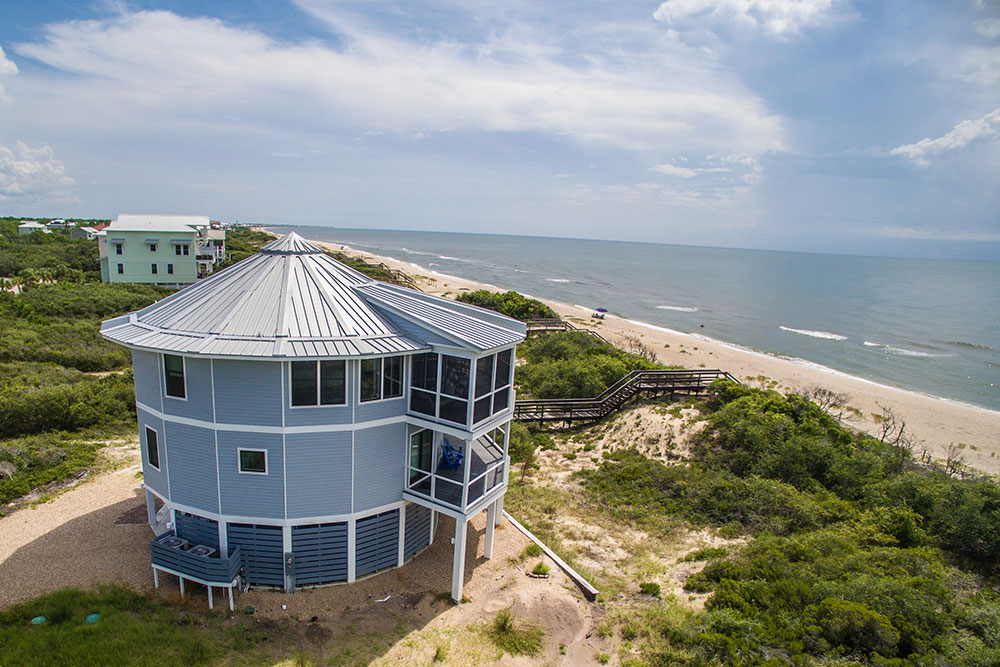
Deltec Homes
Round panelized homes engineered as wind-deflection systems — no flat face for winds to push against. All 26 Deltecs on Black's Island Florida survived Hurricane Michael. Hurricane Ready models rated to 190 mph. Factory panels arrive on a truck and assemble in days.
Est. 1,000 sq ft elevated two-story: $620K–$820K all-in
deltechomes.com →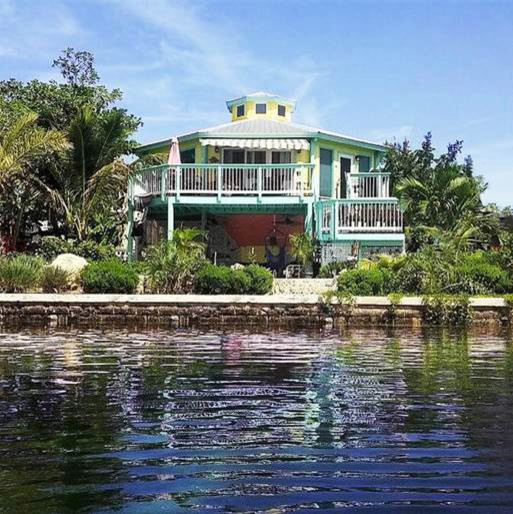
Topsider Homes
Invented the pedestal home in 1968. Built throughout the Florida Keys from Key Largo to Key West. Their post-and-beam system is designed for piling elevation — exactly what's required at 265 Ave G. A Topsider Keys home survived Hurricane Irma intact.
Est. 1,000 sq ft elevated two-story: $640K–$850K all-in
topsiderhomes.com →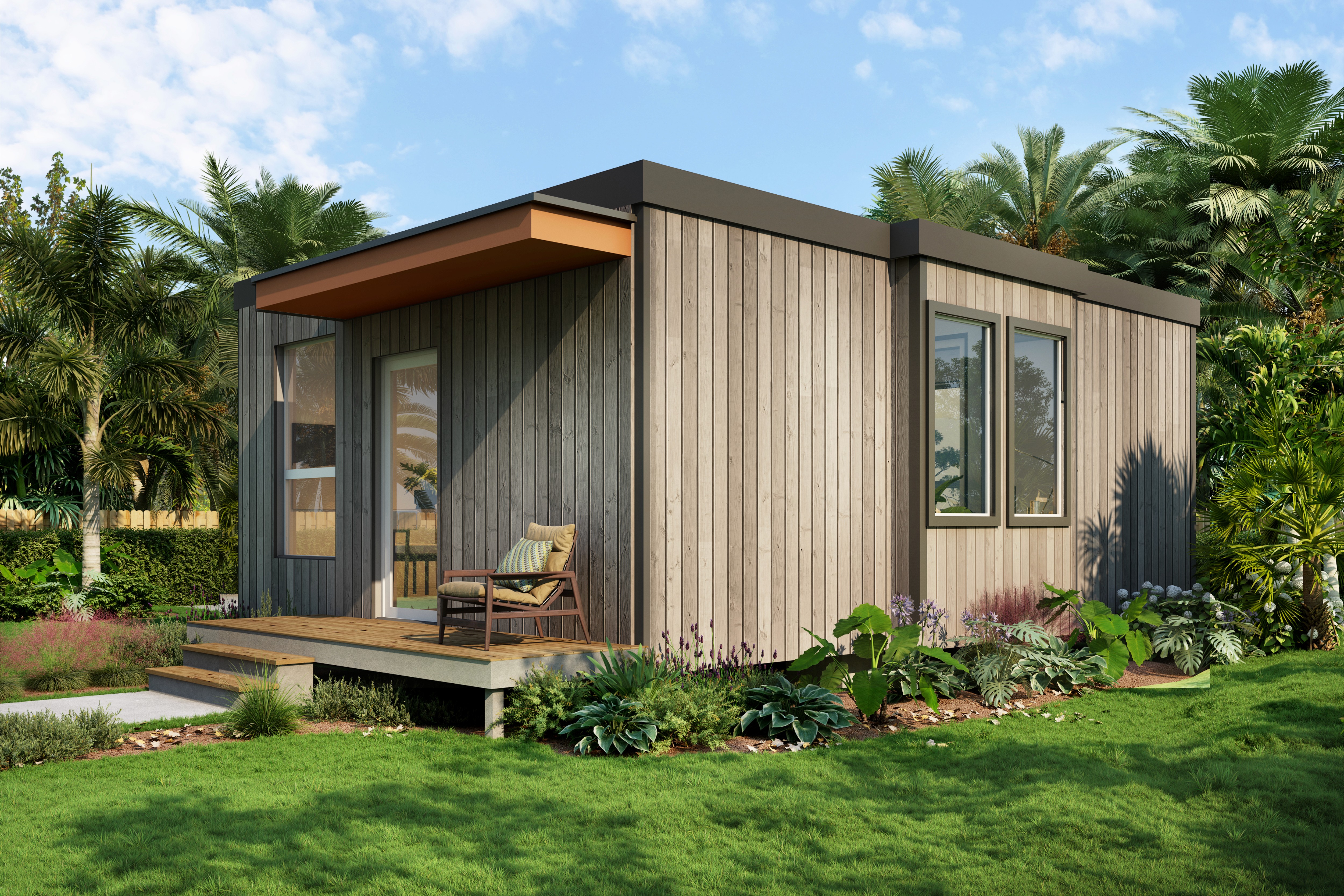
Mesocore
Florida-based modular ADU specialist. Engineered for 180 mph winds, impact-rated windows and doors, solar-ready design. On-site installation in as little as 10 days — critical in the Keys where contractor availability is the primary schedule risk. BPAS application experience.
Est. 1,000 sq ft elevated two-story: $580K–$760K all-in
mesocore.com →Architectural Concepts
All four concepts share the same core: 1,000 sq ft conditioned over two stories, elevated on pilings, with a rooftop deck. Each takes a different aesthetic approach.
Concept A — Elevated Keys Cottage
Classic Florida Keys vernacular, two-story. Ground level: open parking, storage, outdoor shower on pilings. First floor (500 sq ft): open living/kitchen/dining. Second floor (500 sq ft): bedrooms and bath.
- Rooftop deck via straight stair from second floor, 42" railing, panoramic views
- Wraparound covered porch on first and second floors
- Standing-seam metal roof, hardieboard lap siding
- White-and-seafoam palette, louvered Bahama shutters
Concept B — Modern Cabana Studio
Two-story on pilings with a flat roof that becomes the rooftop deck. First floor (500 sq ft): open living/kitchen with floor-to-ceiling impact glass on the pool-facing side. Second floor (500 sq ft): primary suite and bath with clerestory windows.
- Full rooftop observation deck with 42" cable railing, sunset and bay views
- Board-formed concrete accent wall, natural ipe decking
- Hidden from the street, opens entirely to the rear yard
Concept C — Bahamian Conch Cottage
Traditional conch style, two-story. Steep gable, dormers, picket railings, standing-seam tin roof, pastel siding. First floor (500 sq ft): living/kitchen/porch. Second floor (500 sq ft): sleeping loft and bath.
- Widows-walk style rooftop deck with white picket railing — historically authentic Keys detail
- Interior ladder or exterior stair to rooftop
- Pilings disguised with lattice screens
Concept D — Garage + Loft ★ Recommended
The mandatory piling elevation becomes productive square footage. Ground level (unconditioned): 2-car garage, workshop, fishing gear storage, outdoor shower, mechanical room. First floor (500 sq ft): open living/kitchen/dining, covered porch facing the pool. Second floor (500 sq ft): primary bedroom, bath, office nook, covered balcony.
- Rooftop deck via exterior stair from second-floor balcony — the highest vantage point on the property
- Views over the main house roofline toward Florida Bay
- Best cost-per-usable-sq-ft of any configuration
- Ground level at $40–$80/sq ft vs $500–$650/sq ft conditioned
The Lot — Satellite View & Site Plan
265 Avenue G sits on a 23,692 sq ft lot on Vaca Key — large by Keys standards. Below is the live satellite view followed by a proposed site layout showing how the casita, pool, and covered walkway could be arranged.
Proposed Site Layout
Illustrative only — based on 130 ft × 182 ft lot estimate. Commission a boundary survey before design.
What It Could Look Like
Based on Concept D (Garage + Loft) — the recommended configuration. Three levels: open garage below, two conditioned living floors above, rooftop observation deck on top.
The View Looking South from the Rooftop Deck
At ~32 ft above grade, the casita rooftop clears the main house roof (~16 ft) entirely. Looking due south across Avenue G, you'd see your neighbor at 263 Avenue G — a large 2007-era two-story elevated home (~3,500 sq ft, ~28 ft tall) — before the view opens to Marathon's tree canopy and, in the far distance, the Atlantic side of the island.
The View From Up There
At 28–32 ft above grade in Marathon, the rooftop deck clears the tree canopy and neighboring rooflines. Views toward Florida Bay and the Atlantic — unobstructed in all directions.
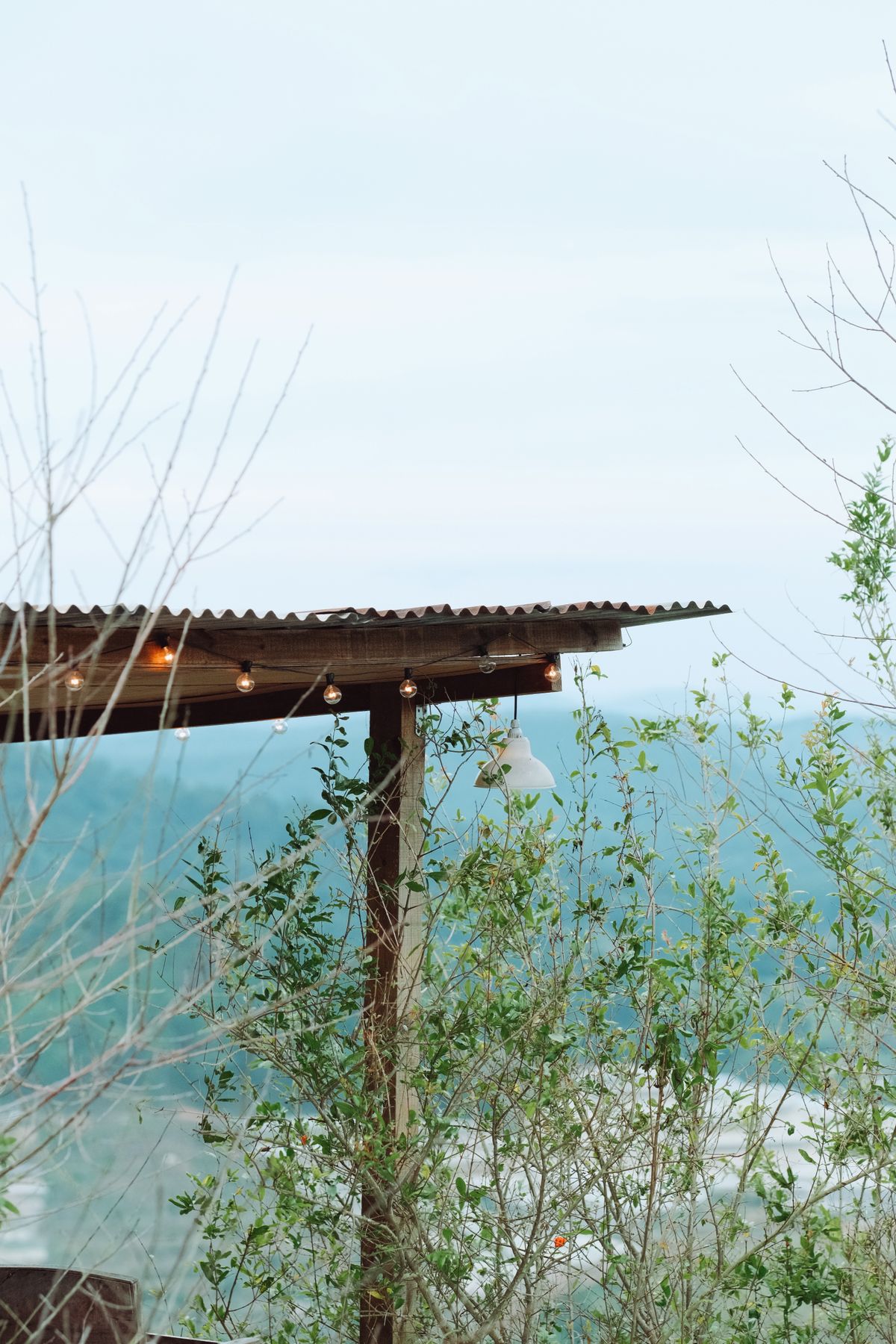
Illustrative rooftop deck concept. Photo: Pexels (free license). Actual deck will feature Keys views, cable railing, and standing-seam metal parapet.
Site Placement
A boundary + topo survey is required before design — these are principle-based guidelines only.
- Rear of lot — maximizes privacy, simplest setbacks
- Long axis east-west — captures SE trade winds, minimizes west sun
- 20–30 ft separation from main house — preserves detached ADU status, allows pool/courtyard between
- Connected by covered walkway — functional link without attachment
- 10 ft from all fences — even if code allows 5 ft, 10 ft avoids neighbor friction
- Preserve mature trees — shade is gold in the Keys and increases appraisal
Next Steps
-
Call Marathon Planning — (305) 289-5057 Ask: "Does a 1,000 sq ft ADU require a BPAS allocation post-SB-48, and what is the current queue for parcel 00364500-000000?" This single call reveals whether this is a 2026 project or a 2028 project.
-
Commission a boundary + topographical survey ~$2,500–$4,500. Non-negotiable before design. Confirms buildable envelope, tree locations, and exact setback lines.
-
Pull FEMA flood zone + BFE Marathon is updating flood maps. Datum shift (NGVD29 → NAVD88) = ~-1.5 ft average. Confirm your BFE before designing finished floor elevation.
-
Confirm sewer service capacity for two units The property is on city sewer — no septic upgrade risk. Confirm with Marathon Public Works that the existing service line and meter can handle a second dwelling unit (~150–200 gallons/day added load). This is typically a quick call and rarely an issue on municipal sewer.
-
Interview 2–3 Marathon-local GCs and 2 architects Architects with BPAS scoring experience are especially valuable — design choices affect your point score and wait time.
-
Decide: modular shell or full site-built? Request quotes from Mesocore, Deltec, and Topsider alongside local GCs. Modular can save 20–30% and 6–8 weeks.
-
File BPAS application As soon as zoning path is confirmed — the allocation clock starts at filing, not at design completion.
Vacation Rental Rules
This is one of the most important sections if rental income is part of the casita's purpose. The answer is nuanced: long-term rental is easy, short-term rental is tightly controlled.
The Two Categories — and Why They Matter
| Type | Definition | Marathon Status |
|---|---|---|
| Long-term rental | 31+ days per stay | ✓ Generally permitted in residential zones. Fewer restrictions, no vacation rental license required. |
| Short-term rental (STR / vacation rental) | 30 days or fewer per stay | ⚠ Requires a Marathon Vacation Rental License. Licenses are capped and regulated under Monroe County's Area of Critical State Concern rules. |
Short-Term Rental Licensing in Marathon
Marathon requires a separate Vacation Rental License for any rental under 28 days. This is administered through the city's Code Compliance department and is separate from the state DBPR (Florida Dept of Business and Professional Regulation) license, which is also required.
What This Means for the Casita
- Private use or long-term rental: No vacation rental license needed. Full flexibility. No cap issue. Simplest path.
- Airbnb / VRBO / nightly rental: Requires a Marathon Vacation Rental License, a Florida DBPR license, and collection of Monroe County Tourist Development Tax (TDT). License availability is uncertain — verify before counting on this income.
- 30-day minimum rentals: A practical middle ground — monthly furnished rentals avoid the STR license requirement while still generating rental income. Marathon and the Keys have strong demand for monthly rentals from seasonal workers, contractors, and remote workers.